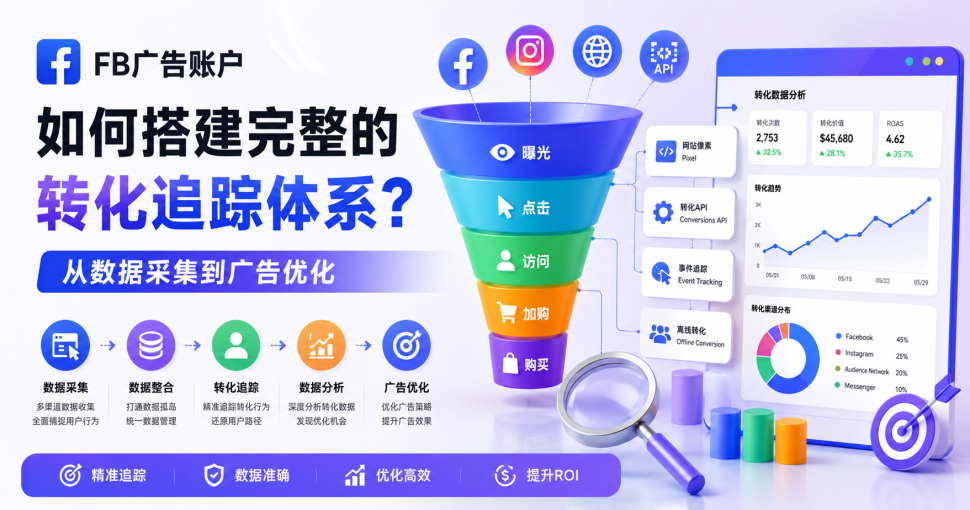
How to build a complete conversion tracking system for your Facebook ad account? From data collection to ad optimization
For cross-border e-commerce, independent websites, and overseas brands, the ultimate goal of advertising is not simply to get clicks, but to understand the complete process from user exposure to final conversion.
Therefore, how to build a complete conversion tracking system using Facebook advertising accounts has become a very important part of overseas advertising operations.
Many advertisers only focus on clicks and impressions in their ad backend, neglecting user behavior after they enter the website. Without accurate data tracking, ad optimization often relies solely on experience-based judgment.
Why is conversion tracking important for Facebook advertising accounts?
Facebook's advertising system needs to use user behavior data to determine which users are more likely to convert.
Common data includes:
- Page browsing
- Product View
- add to the cart
- Initiate checkout
- Complete purchase
- Form submission
The more complete this data is, the easier it is for advertisers to understand user behavior.
At the same time, Facebook ad accounts can also optimize ad placement based on accumulated data.
Step 1: Define the core conversion goals
Before setting up a tracking system, businesses need to define their advertising goals.
For example:
In cross-border e-commerce, you can focus on purchasing and adding items to your cart.
SaaS companies can focus on registration and trial.
Service-oriented businesses can focus on form submissions and inquiries.
Different business operations require different core conversion events.
Step 2: Configure website data tracking
Businesses can configure appropriate data tracking tools based on their own website structure.
Focus on the user's behavioral path after entering the website from the advertisement:
Ad click → Page visit → Product browsing → Add to cart → Checkout → Purchase.
By fully recording these behaviors, advertisers can identify at which stage users churn.
Step 3: Analyze the relationship between advertising and actual conversions
Many ads have high click-through rates, but the final conversion rate is not ideal.
This may indicate that:
- The material attracted the wrong users
- Inconsistent landing page information
- Product prices are not competitive.
- The checkout process is too complicated.
Therefore, you can't just look at click data.
The quality of an ad needs to be judged based on the final conversion data.
Step 4: Optimize ads using data
Once a Facebook ad account has accumulated enough conversion data, advertisers can further optimize it:
- Audience
- material
- landing page
- Advertising objectives
Gradually improve overall advertising efficiency.
Develop a data attribution mindset
Different advertising channels may simultaneously affect user conversion.
For example, a user might:
This is the first time I've seen an ad on Facebook.
I learned about the brand a second time through a search engine.
Finally, visit the website directly to complete the purchase.
Therefore, businesses need to analyze the value of advertising from the perspective of the overall marketing path, rather than just looking at a single click.
Summarize
Facebook advertising accounts are not only tools for delivering ads, but also important platforms for businesses to acquire user data.
By establishing a complete conversion tracking system, companies can more accurately understand the effectiveness of their advertising and continuously optimize their overseas marketing strategies based on real data.
Latest blog