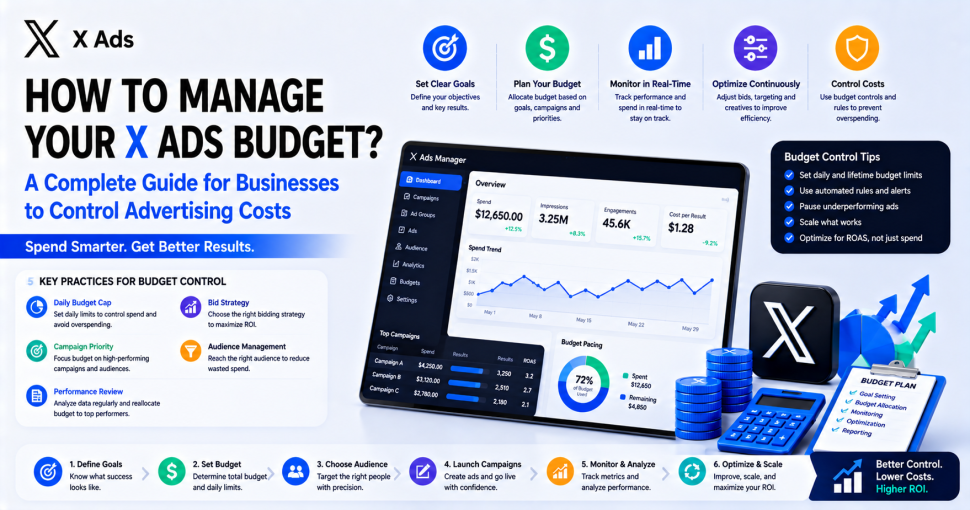
How to manage your X Ads account budget? A guide to controlling advertising costs for businesses.
For companies that have been running X advertising campaigns for a long time, budget management is a very important task.
After purchasing an X advertising account, if the company does not establish a reasonable budget management system, even if the ads themselves have a good number of clicks, there may be problems with the inefficient use of advertising funds.
Therefore, companies should incorporate budget management as part of their advertising operations.
I. Develop a budget based on advertising objectives
Different advertising goals require different budget strategies.
During the new product testing phase, more attention should be paid to market validation.
For mature products, budgets can be set based on historical data.
Brand promotion may focus on exposure and interaction.
E-commerce advertising focuses more on orders and sales.
II. Establish a test budget
When promoting a new product, you can set aside a portion of the budget for testing.
The test content includes:
Different markets;
Different audiences;
Different materials;
Different advertising copy.
Determine the next steps based on the data.
3. Do not allocate the budget equally.
If different ads perform significantly differently, but the budget is still allocated equally, it may reduce overall efficiency.
Businesses can adjust their budgets gradually based on actual data.
IV. Focus on Customer Acquisition Costs
Advertising expenses cannot be analyzed in isolation from business results.
For example:
The advertising cost $1,000;
100 orders were generated;
The average order acquisition cost is $10.
Companies also need to consider whether this cost is acceptable in relation to product profits.
V. Focus on the return on investment in advertising
E-commerce companies can focus on metrics such as ROAS.
If advertising fails to meet a company's profit targets over a prolonged period, the advertising strategy needs to be re-evaluated.
VI. Establish a monthly budget review
Monthly statistics can be compiled:
Total advertising expenditure;
Different market spending;
Expenditure on different products;
Order quantity;
Customer acquisition cost;
Advertising input and output.
Use data to determine the budget strategy for next month.
Summarize
X Ads account budget management is not simply about reducing ad spending.
The real goal is to allocate limited advertising budgets to more effective marketing, product development, and creative advertising.
Through testing, data analysis, and continuous optimization, businesses can gradually build their own advertising budget models.